
The short answer
If your furnace blows cold air, cycles on and off, makes new noises, or won't start, a technician can usually find the cause in one visit. Many problems are repairable. If replacement makes more sense, Bay Area Air District rules and current incentives will shape your options, and we'll walk you through both.
San Jose winters are mild, but the cold, damp nights still make a working furnace matter. Because most South Bay furnaces sit idle through the long, dry summer, problems often show up on the first chilly evening of fall, when dust, worn parts, or a weak igniter finally get tested. Prime Choice HVAC Repair Service diagnoses and repairs gas furnaces for homeowners in San Jose and the surrounding area. This page covers the warning signs to watch for, what we check during a visit, how to weigh repair against replacement under current Bay Area rules, and what affects the cost of the work.
Signs Your Furnace Needs Repair
Furnaces rarely fail without warning. Most give signals days or weeks ahead, and catching them early usually means a simpler repair and less time without heat. These are the most common signs we see in South Bay homes:
- The blower runs but the air coming from the vents is cool or lukewarm.
- The furnace starts, runs briefly, then shuts off and repeats (short cycling).
- Some rooms stay noticeably colder than others, even with the vents open.
- New sounds such as banging at startup, squealing, rattling, or a loud hum.
- A burning smell that lasts beyond the first few minutes of the season's first run.
- The thermostat calls for heat but nothing happens, or the furnace won't stay lit.
- Your heating bill is climbing while your usage habits haven't changed.
- Yellow or flickering burner flames instead of a steady blue flame.
What We Check During a Furnace Repair Visit
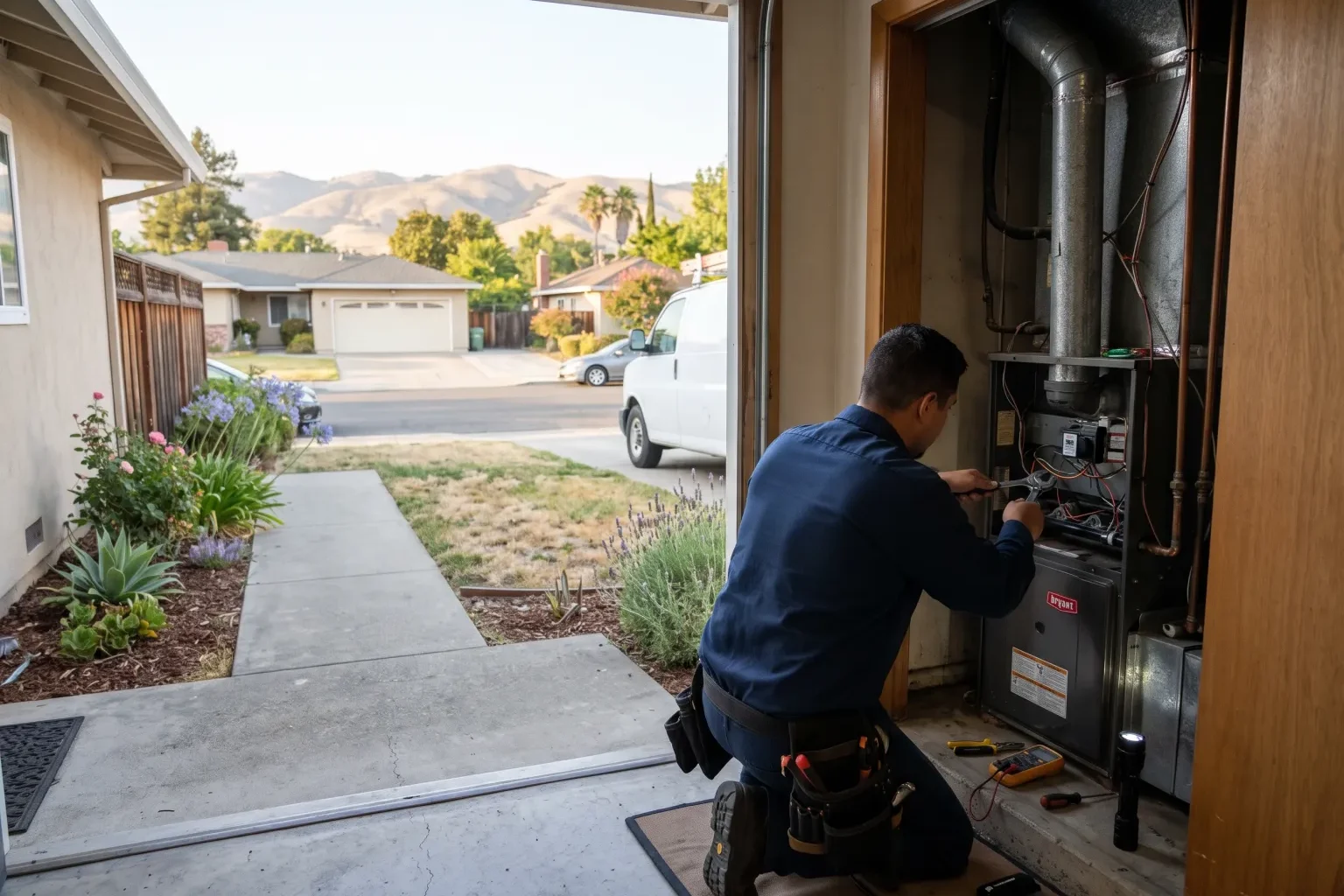
A good repair starts with a full diagnosis, not a guess. Replacing the first part that looks worn can leave the real problem in place. Our technicians work through the system in order, from the thermostat to the vent pipe, so we understand why the furnace stopped working and not only what failed.
On a typical visit we check the following:
- Thermostat settings, wiring, and whether it is actually signaling the furnace
- Air filter condition and airflow through the return and supply ducts
- Igniter or pilot assembly and the flame sensor
- Gas valve operation and burner condition
- Heat exchanger, inspected for cracks or corrosion
- Blower motor, capacitor, and belt, if your unit has one
- Limit switches, pressure switches, and the inducer motor
- Control board error codes and electrical connections
- Flue and venting, checked for blockages and proper draft
- Condensate lines and drain on high-efficiency furnaces
Repair or Replace: Weighing Your Options
Most furnace problems are worth repairing. Igniters, flame sensors, capacitors, switches, and blower motors are routine fixes that can return a furnace to reliable service. Replacement starts to make more sense when the unit is near the end of its expected life, when the heat exchanger is cracked, when major repairs keep stacking up, or when replacement parts are hard to find.
Bay Area homeowners should also know how local air quality rules affect this decision. Under the Bay Area Air District's appliance rules, natural gas furnaces manufactured from 2029 on must meet a zero-NOx emission standard. In practice, that points homeowners toward heat pumps when a furnace is replaced after that date. These rules do not require you to replace working equipment. They apply only when an existing furnace fails or is replaced, so repairing a furnace that still runs well remains a reasonable choice.
If you are considering a heat pump, check what help is available. The federal Energy Efficient Home Improvement Credit covered qualifying heat pumps placed in service before December 31, 2025, and it is not available for new installations after that date. Bay Area homeowners can still check BayREN and their local clean energy provider for heat pump and electrification incentives. Amounts and availability change by funding cycle, so we confirm the current offer before including it in any estimate. We'll lay out the repair option and the replacement option side by side, so you can decide on your own terms.
What Affects the Cost of Furnace Repair
We can't give a fair figure until we've seen the system, because the same symptom can come from very different causes. A furnace that won't light might need a cleaned flame sensor or a new control board. These are the main factors that shape the final cost:
- The specific part that failed, and whether it is a common or brand-specific component
- The age, make, and model of your furnace, which affects parts availability
- How easy the unit is to reach, such as an attic, a crawlspace, or a garage closet
- Whether the diagnosis uncovers more than one problem
- Urgency and timing, including after-hours or peak-season requests
- Any venting, ductwork, or gas line corrections needed for safe operation
How a Furnace Repair Visit Works
When you contact us, we'll ask what the furnace is doing, how old it is, and where it's installed. That helps the technician arrive prepared. At your home, the technician listens to what you've noticed, then runs the diagnostic checks described above.
Before any work begins, we explain what we found in plain terms and give you the repair options and their cost. Nothing proceeds without your approval. If the furnace is unsafe to run, for example because of a cracked heat exchanger or a venting problem, we'll tell you directly and explain why.
After the repair, we run the furnace through full heating cycles to confirm it lights, heats, and shuts off correctly. We'll also point out anything worth watching, such as an aging part that may need attention in a future season, so you can plan ahead instead of being caught off guard on a cold night.
Furnace Repair by city
- Furnace Repair in Campbell
- Furnace Repair in Santa Clara
- Furnace Repair in Los Gatos
- Furnace Repair in Monte Sereno
- Furnace Repair in Saratoga
- Furnace Repair in Cupertino
- Furnace Repair in Milpitas
- Furnace Repair in Sunnyvale
- Furnace Repair in Mountain View
- Furnace Repair in Los Altos
- Furnace Repair in Fremont
- Furnace Repair in Los Altos Hills